
Last Sunday at midnight, the storm began. Thunder and heavy rain rolled in; a familiar lullaby to a Dutch ear. Pre-dawn, around 2 or 3 a.m., the climate turned ominously different, and I braced myself. My apartment leaked from windows and the roof, turning my night into one of mopping, bucket placements, and cautious wakefulness. I stayed alert, prepared to evacuate if things worsened. Once the downpour finally subsided around 5 a.m., I went back to sleep, if fitfully, because I knew I was going to wake up to a different Mindelo. My thoughts went out to the people on the island of São Vicente whose homes would not be able to withstand it. It made me feel so powerless.
During the morning of 11 August 2025, São Vicente was hit by 192.3 millimeters of rain, states the National Institute of Meteorology and Geophysics (INMG). That is nearly a year’s worth of rainfall. This happened after a tropical wave intensified, caused by soon-to-be storm Erin. Therefore, the Cape Verdean government has declared a state of calamity and two days of national mourning.
At least 9 dead and over 1500 displaced
Waking hours later, I texted friends across Mindelo to see how they were doing, if they needed help and what the damage had been. The scale of damage outside was staggering: roads destroyed and submerged in dirt and mud, cars flipped or swept into the sea, water everywhere, and collapsed homes. At least nine people are confirmed dead, several are missing, and over 1,500 displaced. My situation is absolutely nothing compared to what others have had to endure.
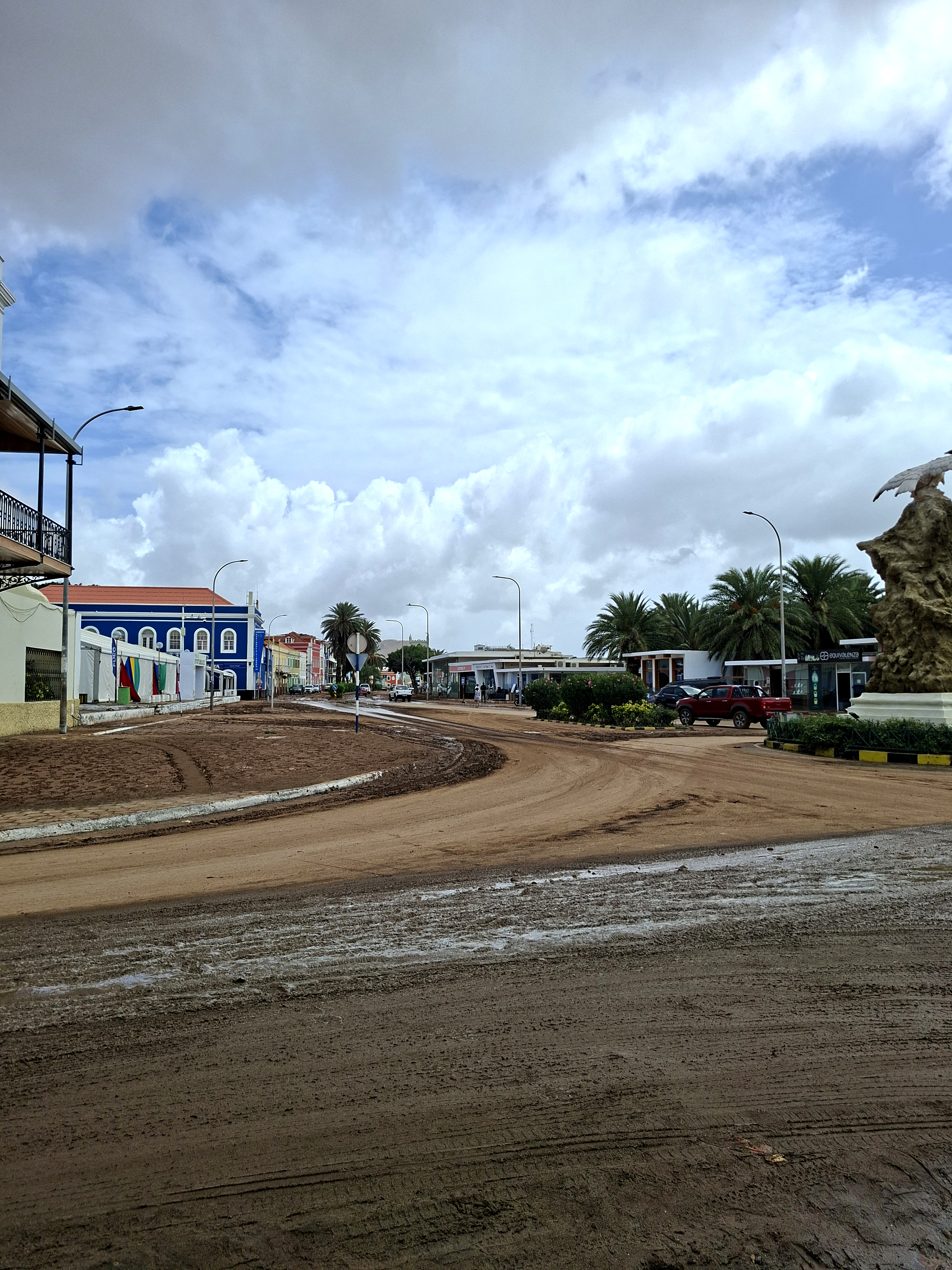


Photo’s by Carmen Esselink
The next night brought more rain, but fortunately not as severe. Power remained cut until around 11 a.m. on Tuesday, after an electrocution incident on Monday. Shortly after, life resumed and the town started buzzing again; stores slowly opening, people doing their groceries, construction on the way.
Water distribution suspended in São Vicente
However, it isn’t all looking up: water distribution is suspended in São Vicente. There isn’t even enough water for fire departments or critical infrastructure like hospitals, according to supplier Electra. The supplier asks people to use their water wisely. Therefore, the local supermarkets are run over, for bottled water and canned goods. People are preparing for an apocalypse, because the worst might be yet to come: the aftermath. Furthermore, because of the flood, there might be health risks through water use.
Then there is the fear: will there be another storm on the way? When will household water return? Will supermarkets be able to stock up now that a lot of the roads are not functioning? Will supplies from abroad reach in sufficient time? From what I’ve heard from locals, there is generally one day of severe rainfall every year, causing some similar problems. But everyone I’ve spoken to has let me know that this is the worst damage they have experienced during their lives.
Disproportionate impact
People are dealing with immediate chaos, but as someone reading up on climate chance, the underlying causes are also coming to my mind. What struck me is how disproportionate the impact was on the most vulnerable. This wasn’t just about weather, it was about inequality built into the urban layout. Flash floods in São Vicente are not new; the island’s geography – with dry stream beds that fill suddenly during heavy rains – is well-documented. But what lay beneath this disaster was the legacy of colonial planning: the water and mud floods that tore through the city center of Mindelo didn’t just damage streets and buildings. They exposed how history and inequality shape the impact of climate disasters. The city’s economic and infrastructural center was built along the coast, in flood-prone zones, while poorer, informal housing developed on steeper slopes internally.
Market women at the open-air vegetable market near the waterfront lost their entire livelihoods overnight. Their pumpkins, mango’s, and zucchini’s are currently floating in the sea. Meanwhile, unplanned tin housing on the hillsides became perilous, prone to mudflows and landslides. This aligns with the notion of ‘sacrifice zones’ in climate vulnerability discussions: areas historically marginalized by planning decisions and socio-economic neglect, now facing the brunt of extreme weather. Those with the least are also those with the fewest resources to prevent damage or to rebuild. Currently, there are fundraising campaigns in Cape Verde and abroad – due to the large numbers of Cape Verdeans living abroad – to aid those impacted most. Also within the city itself, every citizen is trying their best to aid those in need. It is the Cape Verdean community spirit shining through the desperate situation.
Lack of street sewerage and formal stormwater drainage
Mindelo’s vulnerability was also amplified by its lack of street sewerage and formal stormwater drainage. Because rain is infrequent here, sewerage is often deemed unnecessary, but this mindset leaves the city unprepared when extreme downpours do hit. According to local residents and confirmed by academic sources (Martins, Nunes, Lourenço, and Velez-Castro, 2019, and Martins, Lourenço, and Monteiro, 2018), most streets rely on open gutters or nothing at all for water management. In the past, the city had natural drainage paths – dry riverbeds that channelled water to the sea – but many have been paved over or built upon, exacerbating flood impacts. Here, you see the impact of economic power over urban resilience: prime central plots, once vital for water flow, have been sold to investors and developed without provisions for drainage, prioritising short-term commercial gain over long-term safety.
What remains are signs of haste, where informal construction and short-term economic interests override foresighted urban resilience. Without proper runoff channels for water, Sunday’s unprecedented rainfall rushed directly through streets, homes, and marketplaces, turning narrow colonial-era roads into destructive torrents. This will be the sights in my new hometown for a while.

 Carmen Esselink
Leave a comment