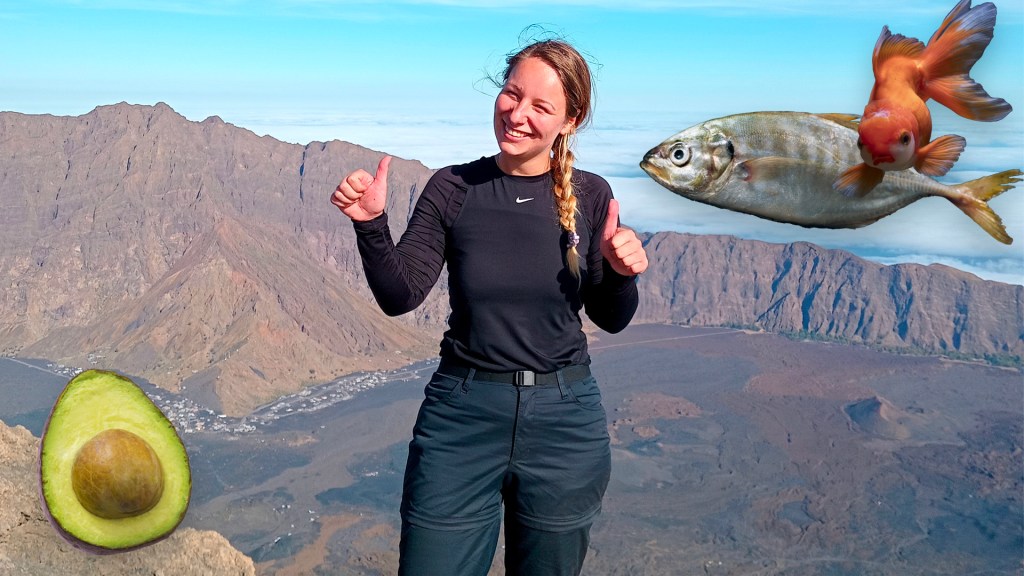
In the beginning of this year, I left the Netherlands as a vegetarian, but soon discovered that maintaining this lifestyle in my new home was way more challenging than I expected. In Cape Verde, a country 400 nautical miles off the coast of Senegal, vegetarianism is not a familiar concept and plant-based options are limited, except when you go to the touristy island Sal. Asking for a dish without fish or meat often results in raised eyebrows and puzzled conversations in which the staff discusses what you’ve actually asked. For example, if you ask for your cachupa – thé local dish – to be without fish or meat, they’ll just pull out the big pieces, but it will still contain small pieces and has been prepared with meat to begin with. It wouldn’t cross their mind to consider why I wouldn’t want to eat meat or fish. Like, why would I?
At first, I struggled with not being able to stick to my vegetarian lifestyle as much as I used to. I converted in 2016 after seeing one of those documentaries on the impact of industrial livestock farming on the environment. Ever since, trying to save the planet one bite at a time became my personal mission. I first focused on my food intake, after that many other sustainable choices followed. So there I went, to an island group in the middle of the sea, eating mostly rice, corn, and beans and finding myself explaining why vegetarianism is such an important principle to me. Why don’t they understand my values?
Well, here’s why… Fish, pigs and chicken are – next to beans, beans, and beans – essential to the Cape Verdean diet. These animals are part of their economic system and deeply integrated into their culture and traditions, even though this is not without its own environmental challenges. Chicken – for example – are raised locally, often walking around freely, without being harmed or overfed. There’s no mass production, just surviving on what’s around you. It’s a far cry from factory farming or keeping cattle in confined spaces.
When it comes to fish, though, the story gets a little grimmer. Even though the expression is ‘there are plenty of fish in the sea’ that abundance has long since disappeared world wide. In Cape Verde this is especially of importance, since fishing is a lifeline for many Cape Verdeans. Small-scale, family run operations make up much of the industry and about 10 percent of the population rely on it for their livelihood. Overfishing and illegal fishing are serious concerns in the country. And there I am, the Dutch traveler, not wanting to eat their fish, goats and chicken?
You might wonder: why not turn to alternative food sources? But those options are limited, because Cape Verde’s food systems are constrained by its geography and agricultural viability. The country that was only settled as recently as the 15th century has always been shaped by its geographic constraints: the arid climate and scarce freshwater resources have made large-scale agriculture nearly impossible. As a result, the options for local food production remain frustratingly limited. The majority of crops that grow here are maize and beans, next to which bananas, sugar cane, sweet potato and cassava. Where does it get the rest of its food? The country’s food needs are met by importing about 82 percent of food products from places as far as Europe and South America. This adds a layer of complexity to the environmental equation and to food security.
According to the World Bank, the environmental impact of Cape Verde’s imports is a big concern, even though the country’s direct CO2 emissions are minimal. Furthermore, the import not only makes it vulnerable to external shocks – as happened for example during the COVID-19 pandemic – but also prevents the development of more resilient food systems. And that is crucial for long-term environmental and financial stability. The story is the same for other small island economies, such as the Maldives or Fiji; places like these are vulnerable to price fluctuations and climate change, because their food systems are too reliant on imports.
This dependency on imported products and on what can be grown or caught locally is why in restaurants you always have to ask what’s available. This unpredictability reflects the country’s dependence on seasonal availability and what can be locally grown and caught, further illustrating the challenges of building a sustainable food system here. Living in Cape Verde has forced me to rethink what sustainability truly means. I began questioning my own practices; whether my vegetarian values – which I held so firmly – are rigid or adaptable to the circumstances here. After all, doesn’t all that long distance travel through air or on sea undermine my goal of reducing my climate impact through food choices?
One thing I deeply admire about Cape Verdeans is how they view food: you don’t waste it. A lot of people are struggling to get food on the table, wherefore there’s a sense of respect for what’s available. Wasting food is simply not an option. If you cannot finish a meal, you box it to take it home or give it to those in need. The one thing you don’t do? Walk to the bin and throw it in. For me, this underscores the blunt contrast between their relationship with food and what I’m used to at home, where overconsumption and waste often go unnoticed or unquestioned.
Three months in, I realize sustainability isn’t just about reducing my meat and fish intake. It’s also about adapting to the local context, even when it doesn’t perfectly align with my values. Making sustainable choices in Cape Verde is a balancing act. The way food is produced and consumed here is more in tune with the environment than in many parts of the world, including the part where I am from. However, the island still struggles with the complexity of global trade, climate change, and local scarcity. As someone who values a vegetarian lifestyle and shops secondhand, I’ve found myself questioning how to live responsibly in a place like Cape Verde, where the climate change solutions that work in Europe and North America don’t necessarily apply.
Cape Verde ranks 181st in total CO₂ emissions out of nearly 200 countries, with only 2.36 metric tons per person. Despite being a very low emitter, it remains one of the most vulnerable countries to climate change. The country is facing rising sea levels and increasingly severe weather. Still, the people of Cape Verde are showing incredible resilience. Local projects, such as small farms using eco-friendly methods and renewable energy initiatives, are providing hopeful solutions to the country’s food and energy problems. Currently, 14 percent of the country’s energy comes from renewable sources. The goal of the government is to reach 100 percent by 2040.
My time in Cape Verde makes it obviously clear that there is no one-size-fits-all solution to the climate crisis. While some of the principles I believe in are vital to the global combat to climate change, Cape Verde requires solutions that fit the specific local needs and realities. It starts with choosing local food, cutting back on imports, and supporting environmentally conscious businesses. Equally important is conserving the limited resources – like water and energy – on the islands. Small, mindful changes like these can already make a big impact.

 Carmen Esselink
Leave a comment